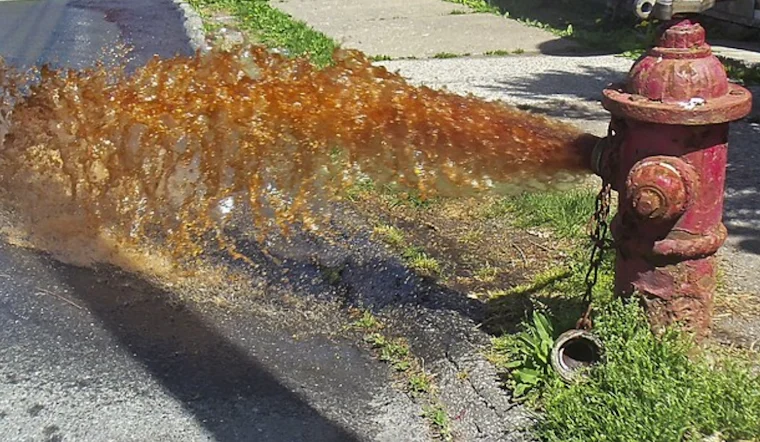
If you have ever seen a fire hydrant gushing water into a city street while a utility worker stands by, you are witnessing the most common cause of “Large-Scale Brown Water Events.” In municipalities across New York and New Jersey, hydrant flushing is a necessary piece of the maintenance puzzle. However, for the homeowner, it is a high-velocity event that can turn clear taps amber in minutes. At BrownWater.org, we help you understand the mechanics of municipal flushing. Understanding the physics behind why hydrant use triggers discoloration is the only way to protect your house from the resulting sediment wave. In dense urban areas, the water grid acts like an interconnected arterial system; a pulse at one end is felt at every faucet.
The Principle of “Hydraulic Scouring” and Shear Stress
In the quiet periods of the day, water moves through the city’s 100-year-old cast-iron mains at a relatively low velocity. This allow fine particles of iron oxide (rust) and mineral sediment to settle at the bottom of the pipe through simple gravity. When a fire hydrant is opened, it creates a massive, localized “Demand Sink”—a point of zero resistance. To fill this sink, the water in the mains must accelerate to an extremely high velocity. This high speed creates “Shear Stress”—a mechanical force that literally “scours” the internal walls of the pipe, knocking loose the “Tuberculation” (brittle rust mounds) that have grown over decades. The result is a concentrated plume of brown water that travels toward the open hydrant and, unfortunately, into any active service lines along the path. This is a primary topic in our guides to municipal maintenance. You can consult the NYC DEP for more on their seasonal flushing schedules, which are designed to remove this sediment deliberately during off-peak hours.
The “Pressure Drop” and Reverse-Flow Vibration Mechanics
Opening a hydrant doesn’t just increase velocity; it causes an immediate and significant “Pressure Drop” in the surrounding local grid. For a multi-story prewar building, this sudden drop can create a temporary vacuum or “Reverse-Flow” situation. As the water is effectively “Sucked” back toward the street to fill the pressure void, it vibrates the interior pipes of your home with an acoustic frequency that is different from normal flow. If your house still relies on original galvanized iron pipes, this vibration is enough to shake loose the internal rust layers. This explains why some residents see brown water during a hydrant flush even if the city’s main street-line is relatively clear. This tracks our diagnostic for pressure-velocity interactions. According to EPA water quality standards, these scouring events are a leading cause of “Secondary Contaminant” spikes. The physical “shaking” of the building’s skeleton is a primary driver of the resulting discoloration.
“Air Intrusion” and Gas Pocket Turbulence
When hydrants are operated, air is often introduced into the street mains through the hydrant’s own venting mechanism. These “Air Pockets” travel through the pipes like high-velocity bullets. When an air slug hits your home’s service line, it creates intense “Hydraulic Turbulence” that is far more aggressive than liquid water alone. This “spitting and coughing” at your faucet is the physical manifestation of air scouring your pipes. At BrownWater.org, we help you diagnose air-water pulse events. Air is an aggressive scouring agent that dislodges sediment that liquid water would normally leave stagnant. For broader health data on urban water surges, the CDC provide essential resources on how these surges can impact overall system integrity.
Proactive Protection: The “Hydrant Event” Protocol
If you see a hydrant being used on your block or in your immediate neighborhood, do not run your water—especially not your high-heat hot water. If you run the tap, you are effectively “Inviting” the sediment plume into your home’s internal mechanical skeleton. Shut off the intake valves to your washing machine, dishwasher, and whole-house filtration system until the city worker has officially closed the hydrant and the “Street Pulse” has moved past your service line. At BrownWater.org, we provide a checklist for managing municipal events. After the hydrant is closed, perform a “Main-Line Flush” from your basement utility sink or bathtub to clear any residual silt before it reaches your delicate kitchen faucet aerators. Success in the city is a matter of defensive plumbing. Municipal water testing in NYC can help investigate discoloration that persists beyond a hydrant event; include the reported flushing schedule and the time each sample was collected when discussing the results with the utility.
“Hydraulic Hammer” Risks during Closure
The closing of a fire hydrant is just as dangerous as the opening. If a worker closes the hydrant too quickly, it sends a “Water Hammer” (a high-pressure shockwave) back through the pipes. This shockwave can vibrate your pipes so intensely that it causes “Pinhole Leaks” in aged galvanized iron or cracks in old lead-solder joints. If your water turns brown *after* the hydrant is closed, you have suffered a “Hammer Event.” This requires a localized inspection of your main shut-off valve. Managing the shockwave is as important as managing the flow. Protecting your home starts with recognizing the external forces that drive internal decay.
Conclusion: The Necessary Pulse of City Engineering
Hydrant flushing is a necessary piece of city engineering, required to remove accumulated silt and ensure fire safety. By recognizing that hydraulic scouring, pressure drops, air intrusion, and water hammer shocks are the drivers of the resulting brown water, you can stay proactive and defensive. Your tap water is a reflection of the grid’s health—respect the pulse, protect your pipes, and always Know Your Tap. At BrownWater.org, we provide the technical data and forensic strategies needed to find clarity in the layers of urban history. A hydrant event is a test of your building’s resilience; make sure you are prepared for the pulse.
Advanced Diagnostic: The “Temporal-Hydraulic Audit”
To truly solve a recurring brown water problem, you must move beyond the basic “Run it and see” method. We recommend performing a Temporal-Hydraulic Audit. This involves logging the exact time, fixture location, and “Time-to-Clarity” for every event over a 7-day period. Use a high-lumen flashlight behind a clear 1-quart glass to check for “Turbidity Micro-Flashing”—tiny sparkles that indicate high-velocity sand or magnetite particles. If the water clears within 30 seconds, the “Source-Node” is likely within 10-15 feet of the faucet (the branch line). If it takes 2-5 minutes, the source is likely the building’s vertical riser. If it takes longer than 10 minutes, the problem is in the city main or the building’s main service line. At BrownWater.org, we provide the technical templates needed to perform these audits effectively.
Using “Thermal Contrast” Testing
Another powerful diagnostic is Thermal Contrast Testing. By comparing the sediment load of the coldest possible water with the hottest possible water simultaneously, you can determine if your water heater’s “Sacrificial Anode Rod” has failed. If the hot water contains “Sharp, Flat Flakes” while the cold water is clear, your heater is actively dissolving from the inside out. If both are brown but the hot water has a “Metallic Smell,” you are likely dealing with Iron-Related Bacteria (IRB) that thrive in the warm, stagnant environment of the tank. Knowing the thermal signature of your brown water is the fastest path to targeted, cost-effective plumbing repairs. Don’t waste money on a whole-house filter if the problem is a $30 anode rod.


