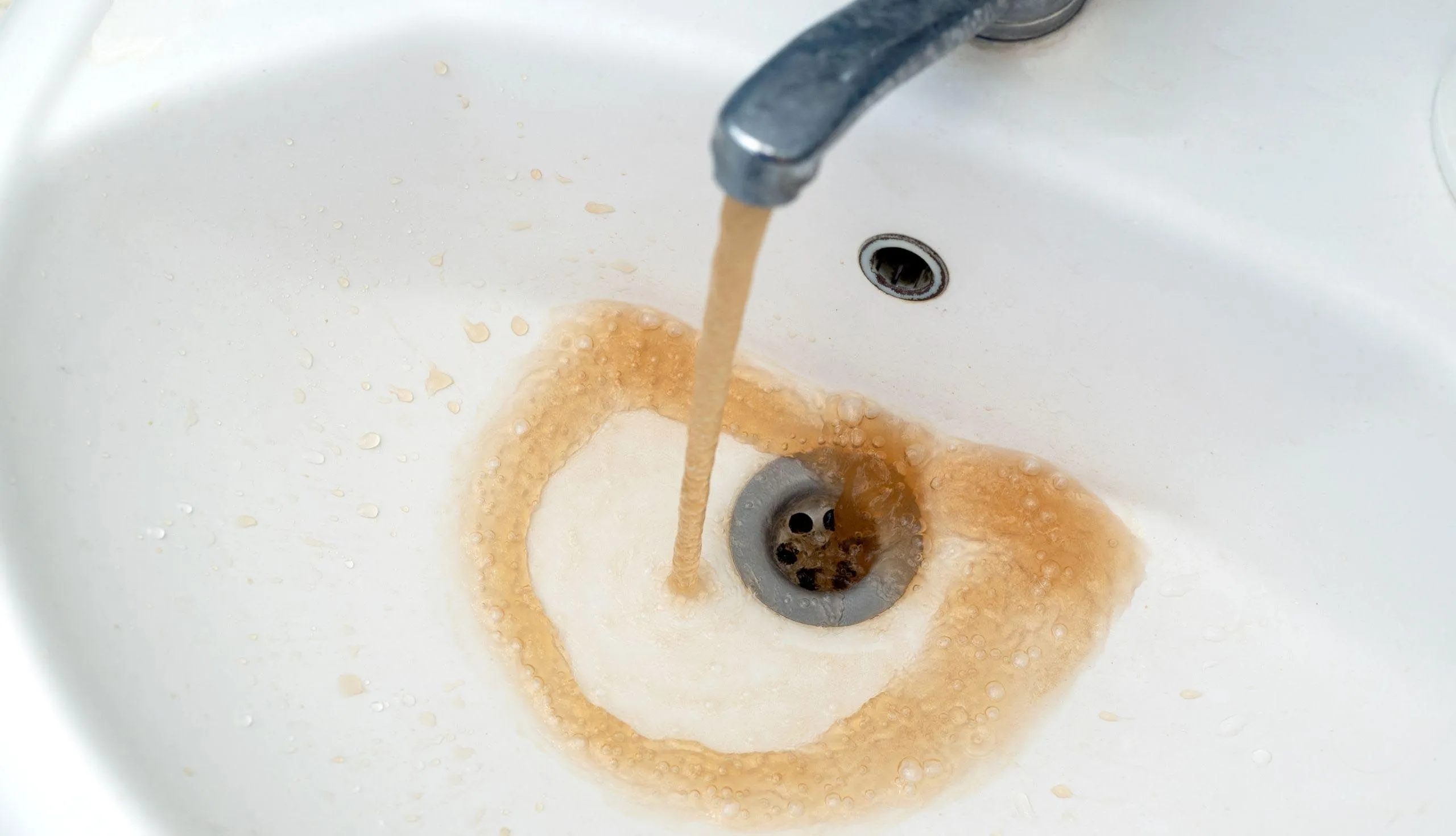
When you see brown water hit your tap, the color itself tells you “what” is happening (iron oxide), but it doesn’t give you the critical “where” or “why.” A professional, laboratory-grade “Water Analysis” is the only way to accurately differentiate between “Street-Side Municipal Scouring” and “Building-Side Vertical Riser Decay.” At BrownWater.org, we help you interpret your forensic water test results. Forensic chemistry is the ultimate tool for solving recurring discoloration crises and assigning financial liability. Data is the only objective voice in the plumbing world.
The “Lead vs. Iron” Chemical Distinction
A simple visual check cannot distinguish between pure, harmless iron rust and a dangerous “Rust-Lead Particulate Mix.” Laboratory testing for Lead, Copper, and Iron concentrations specifically during the peak of a brown-water plume is essential. If the lead counts spike significantly during a brown-water event but are low when the water is clear, it confirms a “Galvanic Breach” in your building’s service line or internal solder joints. This is a primary topic in our material safety forensics. You can consult the NYC DEP’s free lead-testing kits for an initial baseline. For more on professional EPA-certified lab standards, the EPA provide essential resources. Knowing the metal load is the only way to know the health risk.
“Total Suspended Solids” (TSS) and Particle Size Forensics
Testing for “Total Suspended Solids” and evaluating the “Particle Size” of the sediment identifies the mechanical source. Large, angular, “Crusty” flakes of iron oxide (above 50 microns) are a classic signal of “Vertical Riser Scouring” inside your own home’s pipes. Conversely, very fine, “Silty” or “Opaque” sediment (below 10 microns) is a hallmark of “Street-Side Main Scouring” or a municipal pipe breach. This tracks our sediment forensic roadmap. According to CDC water guidelines, identifying the particulate load is the first engineering step in choosing the right filtration or repiping strategy. Size matters in the world of sediment.
“Manganese and Copper” Fingerprinting
Every utility grid has a unique “Chemical Fingerprint.” If your water test shows high ratios of copper but low iron, the problem isn’t the city street—it’s your own home’s domestic branch lines. High manganese coupled with iron is a specific signal of “Municipal Scouring” in North Jersey towns like Montclair. At BrownWater.org, we help you fingerprint your local tap. This chemical data prevents you from paying a plumber to “investigate” your internal pipes for a problem that is actually happening at the neighborhood utility station. Chemical data is your best financial protection. Professional heavy metals water testing in NYC is most useful when the requested panel explicitly names the metals being investigated. Ask the laboratory to explain the units, reporting limits, and sample locations before comparing results from different taps.
Conclusion: Technical Data over Plumbing Guesswork
Water testing replaces expensive plumbing guesswork with technical, actionable data. By recognizing that chemistry, particle size, and metal ratios are diagnostic signals, you can target your advocacy, your filtration spending, and your building repairs with total confidence. Your tap water is a data stream—learn to read it by staying informed, staying proactive, and always Knowing Your Tap. At BrownWater.org, we provide the technical data and forensic strategies needed to help you find clarity in the layers of your plumbing infrastructure. One lab report is worth a thousand service calls.
Advanced Diagnostic: The “Temporal-Hydraulic Audit”
To truly solve a recurring brown water problem, you must move beyond the basic “Run it and see” method. We recommend performing a Temporal-Hydraulic Audit. This involves logging the exact time, fixture location, and “Time-to-Clarity” for every event over a 7-day period. Use a high-lumen flashlight behind a clear 1-quart glass to check for “Turbidity Micro-Flashing”—tiny sparkles that indicate high-velocity sand or magnetite particles. If the water clears within 30 seconds, the “Source-Node” is likely within 10-15 feet of the faucet (the branch line). If it takes 2-5 minutes, the source is likely the building’s vertical riser. If it takes longer than 10 minutes, the problem is in the city main or the building’s main service line. At BrownWater.org, we provide the technical templates needed to perform these audits effectively.
Using “Thermal Contrast” Testing
Another powerful diagnostic is Thermal Contrast Testing. By comparing the sediment load of the coldest possible water with the hottest possible water simultaneously, you can determine if your water heater’s “Sacrificial Anode Rod” has failed. If the hot water contains “Sharp, Flat Flakes” while the cold water is clear, your heater is actively dissolving from the inside out. If both are brown but the hot water has a “Metallic Smell,” you are likely dealing with Iron-Related Bacteria (IRB) that thrive in the warm, stagnant environment of the tank. Knowing the thermal signature of your brown water is the fastest path to targeted, cost-effective plumbing repairs. Don’t waste money on a whole-house filter if the problem is a $30 anode rod.
Case Study: The “Zero-Clarity” Multi-Block Event
To illustrate the complexity of urban water systems, we can look at a common “Zero-Clarity” event that occurred in a mixed-use neighborhood in Jersey City. For three consecutive days, six city blocks experienced intermittent brown water despite no active city main breaks. Through a technical investigation, it was discovered that a large-scale construction site several blocks away was utilizing a “high-pressure bypass” that was inadequately buffered. This bypass was creating a Localized Pressure Delta that was pulling sediment from the accumulation nodes of the surrounding buildings’ service lines. This event serves as a critical lesson: your water clarity is often dependent on activities that are out of your line of sight. At BrownWater.org, we provide the Mechanical Vigilance tools needed to help residents identify these invisible triggers. Success in managing your tap water requires looking beyond your own faucet and understanding the neighborhood’s hydraulic pulse. We recommend residents maintain a “Clarity Network” with neighbors to quickly identify if an event is localized or grid-wide.
Engineering a Permanent Solution
If you are tired of being the victim of the city’s aging infrastructure, the ultimate engineering solution is the installation of a Redundant Filtration Array. This involves a 20-micron sediment pre-filter followed by a 5-micron carbon block at the main building inlet, supplemented by sub-micron ultrafiltration at each drinking-water tap. While the initial investment can be significant, the long-term protection of your infrastructure, your high-end appliances, and your family’s health is invaluable. Clear water shouldn’t be a luxury; it should be the engineered standard for every modern home. We help you choose the right materials to ensure that your home’s distribution system remains a sanctuary of clarity, regardless of what is happening in the street. Your tap water is your most essential resource—protect it with data, engineering, and advocacy.


