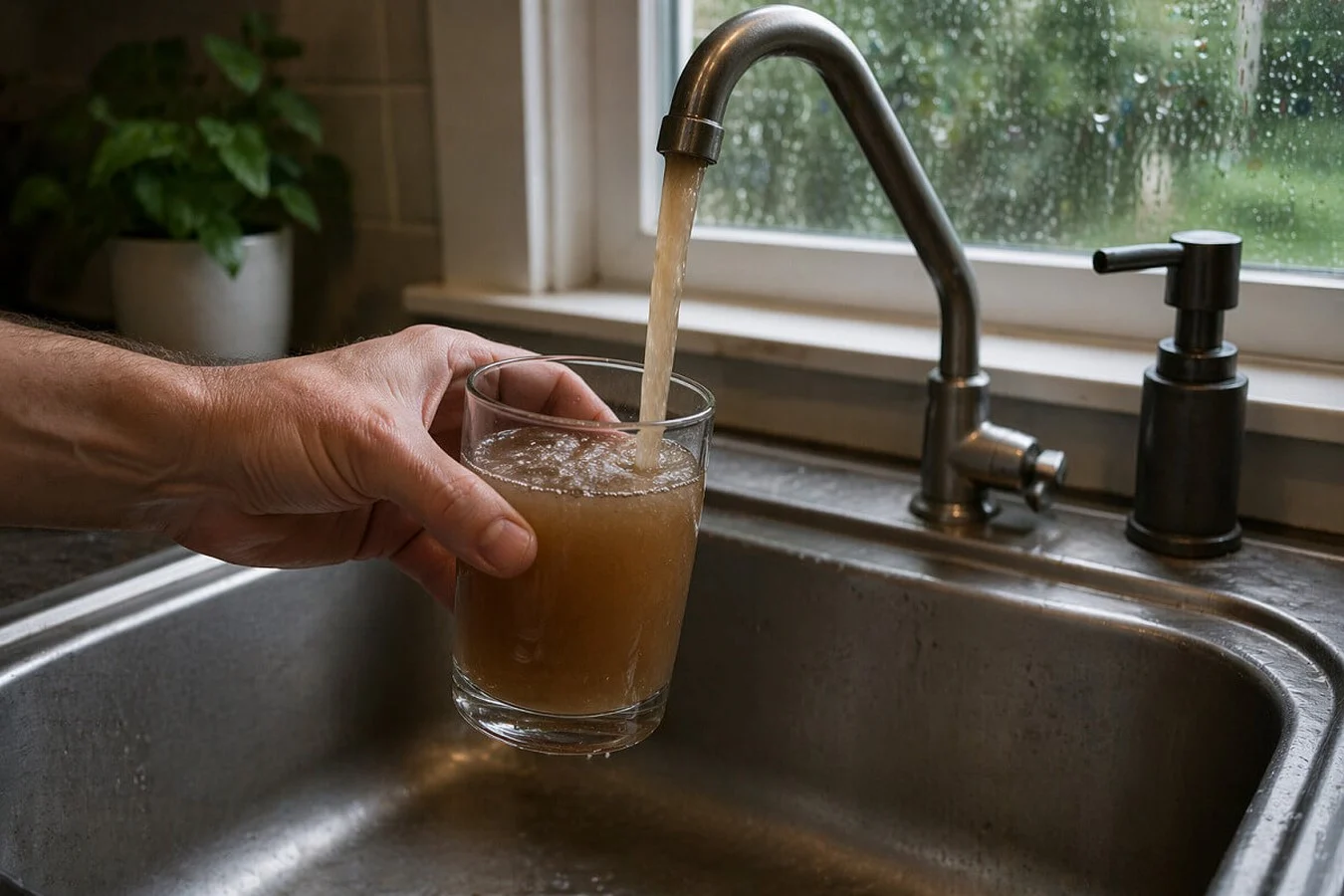
Jersey City’s historic neighborhoods—from the brownstones of Van Vorst Park to the high-rises of the Waterfront—experience a statistically high frequency of brown water events following “Major Storms” and heavy rainfall. While many residents blame the “Rain” itself, the cause is actually rooted in the “Hydraulic Stress” that storm-water puts on the city’s aging “Combined Sewer and Water Infrastructure.” At BrownWater.org, we focus on the specific utility challenges of Jersey City. Understanding the link between Mother Nature and your tap water’s clarity is the first step in protecting your home during the next “Jersey Side” storm. On the coast, the weather is more than an atmospheric event; it is a hydraulic pressure variable.
The “Subsidence and Vibration” Cycle in Jersey City
Jersey City is built on a “Back-Barrier” landscape with varied soil quality, ranging from rocky heights to sandy lowlands near the river. During a major storm, the soil becomes saturated and “heavy.” This weight causes “Differential Subsidence”—the ground literally shifts and “drops” by fractions of an inch. Because Jersey City’s water mains are primarily 100-year-old cast iron, they are “Brittle.” This soil shifting acts as a “Seismic Pulse” that vibrates the mains and knocks loose the internal iron rust (Tuberculation). The brown water you see after a storm is the “internal skin” of the city mains being shaken loose by the weight of the rain. You can see more about the Jersey City Municipal Utilities Authority’s (JCMUA) infrastructure maps for more local data on these fragile segments.
The Impact of “Combined” Infrastructure Surges and Cross-Stress
Jersey City, like many older industrial cities, has areas with “Combined” systems or closely-packed utility corridors. Heavy rain creates massive “Inflows” into the storm drains, which increases the external pressure on the water mains buried alongside them. This “External Pressure Surge” can cause micro-movements in the water main joints, stirring up the “Settled History” (the silt and rust at the bottom of the main) and moving it into the service lines. This is a primary topic in our storm-side diagnostic guides. In Jersey City, the “Rain above” is a direct trigger for the “Rust below.” For broader guidelines on urban water safety during weather events, the CDC provides essential resources. The physical weight of the runoff creates a “Geological Squeeze” on the aging pipes.
Main Breaks and “Thermal Shocks” in the Hudson Basin
Storms often follow sudden changes in temperature. Cold rain hitting “warm” urban ground creates a “Thermal Shock” for the metal pipes buried just a few feet below the asphalt. This rapid “Contraction” of the cast iron mains is a leading cause of “Main Breaks” in Jersey City. When a main breaks during a storm, the city must “Valves-Off” sections of the grid. Re-opening those valves sends high-velocity water into neighborhoods that haven’t been flushed in years, resulting in a building-wide brown water plume. According to the NJ DEP’s water supply guidelines, these events are aesthetic in nature but require specific homeowner purging. We provide a post-break clearance protocol specifically for Jersey City residents who live near high-break-frequency corridors.
The “Sewer Backwater” Pressure Conflict and Vibration
For residents in low-lying areas like Bergen-Lafayette or downtown, heavy storms create “Back-Pressure” in the sewer lines. While this doesn’t directly enter your water supply, the “Vibrations” of the surging sewer main (which is often larger and runs parallel to the water main) are transferred to the water line. This “Parallel-Utility Vibration” is highly effective at scouring sediment. Residents should check our guide for building-wide resilience to see how to protect their units during a Jersey City deluge. Protection is a matter of understanding the “communal vibration” of the block. When the sewer main is at full capacity, the resulting “Infrasonic Resonance” can strip 50 years of rust from the water main in minutes.
Water Main “Venting” Failures During Heavy Runoff
During intense storms, the city’s “Valve Vaults” can flood, preventing proper air venting from the water mains. This causes “Air Pockets” to travel through the system. These air pockets move at higher velocities than water and act like “Mechanical Scrapers” inside the old iron pipes. If you hear your faucet “coughing” after a storm, you have an air-venting failure in your neighborhood grid. This is a common Jersey City phenomenon that directly accelerates brown water events. At BrownWater.org, we emphasize the link between air intrusion and sediment. Air is the enemy of a clear, calm plumbing system. Across the Hudson, Municipal water testing in NYC also depends on documenting the timing of storm-related pressure changes and discoloration. For a Jersey City investigation, use local utility notices and sampling locations; results from another water system cannot establish conditions at your tap.
Health and Safety: Is Storm-Induced Brown Water Safe?
Generally, discoloration following a storm is “High-Concentration Iron Oxide” and is not technically “Safe” to drink according to EPA secondary standards, but it does not represent a “Boil Water Advisory” unless the JCMUA issues one. However, the sediment can harbor lead if your building has original lead service lines or lead-solder joints. Understanding the health and safety context is vital. At BrownWater.org, we recommend using bottled water for drinking and cooking until the “Storm Plume” has been fully cleared from your taps. Don’t risk the mineral load until your taps have returned to absolute transparency.
Conclusion: Weather-Proofing Your Tap in the Garden State
Jersey City’s brown water events after storms are the predictable result of aging iron mains, soil subsidence, and thermal shocks. By recognizing the “Jersey Side” variables—especially the link between combined infrastructure and subterranean vibrations—you can better prepare your home with whole-house filtration and a proactive clearance plan. Your water clarity is a reflection of the city’s geological and mechanical stability—stay informed, stay proactive, and always Know Your Tap. At BrownWater.org, we provide the technical roadmap you need to ensure your home remains a sanctuary of clarity even when the clouds open up over the Hudson. Your tap is the final indicator of the city’s weather resilience.
Technical Appendix: The “City-Grid” Failure Modes
Understanding the broader context of urban hydraulics is essential for any resident of NYC or Northern NJ. The city’s water mains, many of which are constructed of cast-iron with “Leadite” joints, are sensitive to three primary failure modes that frequently trigger brown water events. First, there is Static Scouring, which occurs when a large volume of water is drawn from a single point (like a fire hydrant), reversing the flow in the local grid and pulling sediment from the accumulation nodes. Second, there is Thermal Siphoning, where temperature differentials between the city main (often as low as 40°F in winter) and your building’s internal risers (at 70°F) create a slow-moving convection current that keeps iron particles suspended rather than allowing them to settle. Finally, there is Seismic Pulses caused by heavy vehicle traffic and subway lines, which act as a constant, low-frequency mechanical agitator against the brittle iron-oxide lining of the pipes. At BrownWater.org, we track these “Neighborhood Pulse” events to help residents predict clarity cycles.
The “Hydraulic Shadow” Effect
When major construction happens on a primary main, it creates what we call a “Hydraulic Shadow” on the adjacent blocks. While the street being worked on is clearly alerted, the “Shadow” blocks often experience sudden, unexpected brown water pulses due to the closure of critical grid valves. If you are seeing brown water and there is no construction on your block, look “Up-Grid” toward the nearest major avenue or boulevard. The city’s grid is interconnected, and a valve closure three blocks away can change the pressure and velocity in your apartment in seconds. Documentation of these shadow events is a key part of building a case for municipal accountability. Stay informed, stay proactive, and always Know Your Tap.


