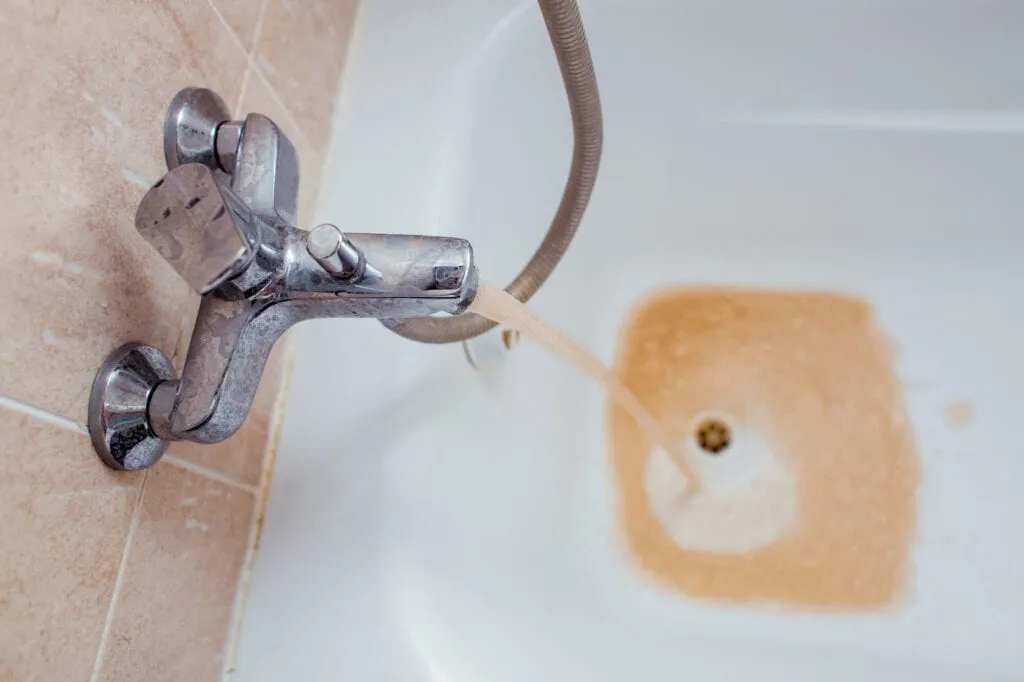
There is nothing more discouraging than waking up, turning on the kitchen tap for a fresh glass of water, and being greeted by a “Spurt” of dark brown or rusty liquid. This “Morning Burst” is a classic plumbing symptom with a very specific engineering explanation. In the world of historic urban housing, this 7 AM brown water is almost never a “Street-Side” problem; it is the physical evidence of “Internal Stagnation” and pipe decay. At BrownWater.org, we help you decode the signals of your morning tap. Understanding why your faucet “spits” brown water is the first step in identifying which specific pipe in your home is failing and how to stop the rust before it spreads.
The Principle of “Static Oxidation”
During the night, while you are sleeping, the water in your pipes is “Static”—it isn’t moving. If your home has original “Galvanized Iron” pipes, the water is sitting in direct contact with the rusting interior wall of the pipe. Over 8 hours, the iron in the pipe reacts with the oxygenated water through a process of “Static Oxidation,” reaching a “Saturation Point” where the water is dyed a deep amber or brown. When you turn the faucet on in the morning, you are flushing out that “Overnight Volume.” This is a primary topic in our internal pipe decay guides. For deeper context on municipal iron and water quality, visit the NYC DEP’s quality dashboard.
“Galvanic Hotspots” at the Faucet Connection
If the “Spurt” only lasts for 2 to 5 seconds and then turns crystal clear, the problem is localized exactly where the faucet connects to the wall. In many NYC and NJ renovations, high-end “Brass” or “Stainless Steel” faucets are connected directly to old iron pipes. This creates a “Galvanic Hotspot”—a tiny battery where the iron is rapidly dissolved into the stationary water. The first “Spurt” is the concentrated rust that collected at that single joint overnight. This Tracks our material-interface diagnostic guides. According to EPA water standards, these localized releases are often aesthetic but indicate a high risk of “Pinhole Leaks” at the connection point.
The “Service Main” Morning Flush
If the “Spurt” takes about 30 to 45 seconds to appear and then clears up quickly, the source is your “Service Main”—the pipe under your front yard or sidewalk. The water that travels from the street main to your basement has to sit in that service line all night. If that service line is iron (very common in Brooklyn and North Jersey), the “Morning Burst” is the volume of that external pipe entering your home. Understanding this hydraulic timing metric is essential for identifying your repair liability. For more on healthy water and lead service line risks, the CDC provides extensive resources.
The Impact of “Air Pockets” on Sediment Scouring
Why does it “Spit” or “Cough”? If your plumbing has a small “Atmospheric Leak” or if the city has recently performed repairs, a tiny air pocket can collect at the “High Point” of your bathroom or kitchen faucet overnight. When you turn the tap on, the “Compressed Air” escapes with high velocity, creating a turbulent “Scouring Wave” that rips the loose rust (Tuberculation) off the pipe walls. This results in a “Dirty Spurt” rather than a smooth flow. At BrownWater.org, we help you diagnose atmospheric-water interactions. A “spitting” faucet is a sign of a “Non-Airtight” system, which is a structural red flag.
Why Hot Water “Morning Bursts” are Worse
If your morning brown water is only found in the “Hot” tap, the explanation is thermal acceleration. Heat acts as a catalyst for oxidation; the water inside your heater’s “Hot-Side Riser” is much more aggressive at eating the pipe walls overnight than the cold water. Furthermore, if your “Anode Rod” is spent, the heater tank itself is shedding sediment while the house is at rest. This tracks the thermal-side decay variables we document on our site. Protecting your morning coffee starts with protecting your hot water infrastructure. Home and residential water testing in NYC can help investigate the morning pattern when the sampling plan distinguishes water collected after overnight stagnation from water collected after flushing.
Mitigation: The “Morning Purge” Protocol
If you have morning brown water, do not use the first “Spurt” for drinking or cooking. Professional-grade protocol involves a “30-Second Flush” of the cold water before any usage. This clears the static volume and ensures you are drawing fresh, clear water from the city main. Additionally, installing a “Dielectric Union” at the faucet connection can stop the galvanic hotspot in its tracks. At BrownWater.org, we believe that mastery of your morning routine is the key to house preservation. Know your faucet, respect the static volume, and always Know Your Tap.
Conclusion: Decoding the Static Signal
Waking up to brown water is not a random event; it is a diagnostic signal of static oxidation, galvanic hotspots, or service-line decay. By observing the duration of the “Spurt” and the timing of its arrival, you can accurately identify which pipe segment is reaching its end of life. Your home is a machine that requires a clean “Arterial Start”—stay informed, stay proactive, and always Know Your Tap. At BrownWater.org, we provide the technical data and forensic strategies needed to ensure your first glass of water is as clear as your morning vision.
Advanced Diagnostic: The “Temporal-Hydraulic Audit”
To truly solve a recurring brown water problem, you must move beyond the basic “Run it and see” method. We recommend performing a Temporal-Hydraulic Audit. This involves logging the exact time, fixture location, and “Time-to-Clarity” for every event over a 7-day period. Use a high-lumen flashlight behind a clear 1-quart glass to check for “Turbidity Micro-Flashing”—tiny sparkles that indicate high-velocity sand or magnetite particles. If the water clears within 30 seconds, the “Source-Node” is likely within 10-15 feet of the faucet (the branch line). If it takes 2-5 minutes, the source is likely the building’s vertical riser. If it takes longer than 10 minutes, the problem is in the city main or the building’s main service line. At BrownWater.org, we provide the technical templates needed to perform these audits effectively.
Using “Thermal Contrast” Testing
Another powerful diagnostic is Thermal Contrast Testing. By comparing the sediment load of the coldest possible water with the hottest possible water simultaneously, you can determine if your water heater’s “Sacrificial Anode Rod” has failed. If the hot water contains “Sharp, Flat Flakes” while the cold water is clear, your heater is actively dissolving from the inside out. If both are brown but the hot water has a “Metallic Smell,” you are likely dealing with Iron-Related Bacteria (IRB) that thrive in the warm, stagnant environment of the tank. Knowing the thermal signature of your brown water is the fastest path to targeted, cost-effective plumbing repairs. Don’t waste money on a whole-house filter if the problem is a $30 anode rod.


